ePRO / eCOA · Patients
CuRE Compass
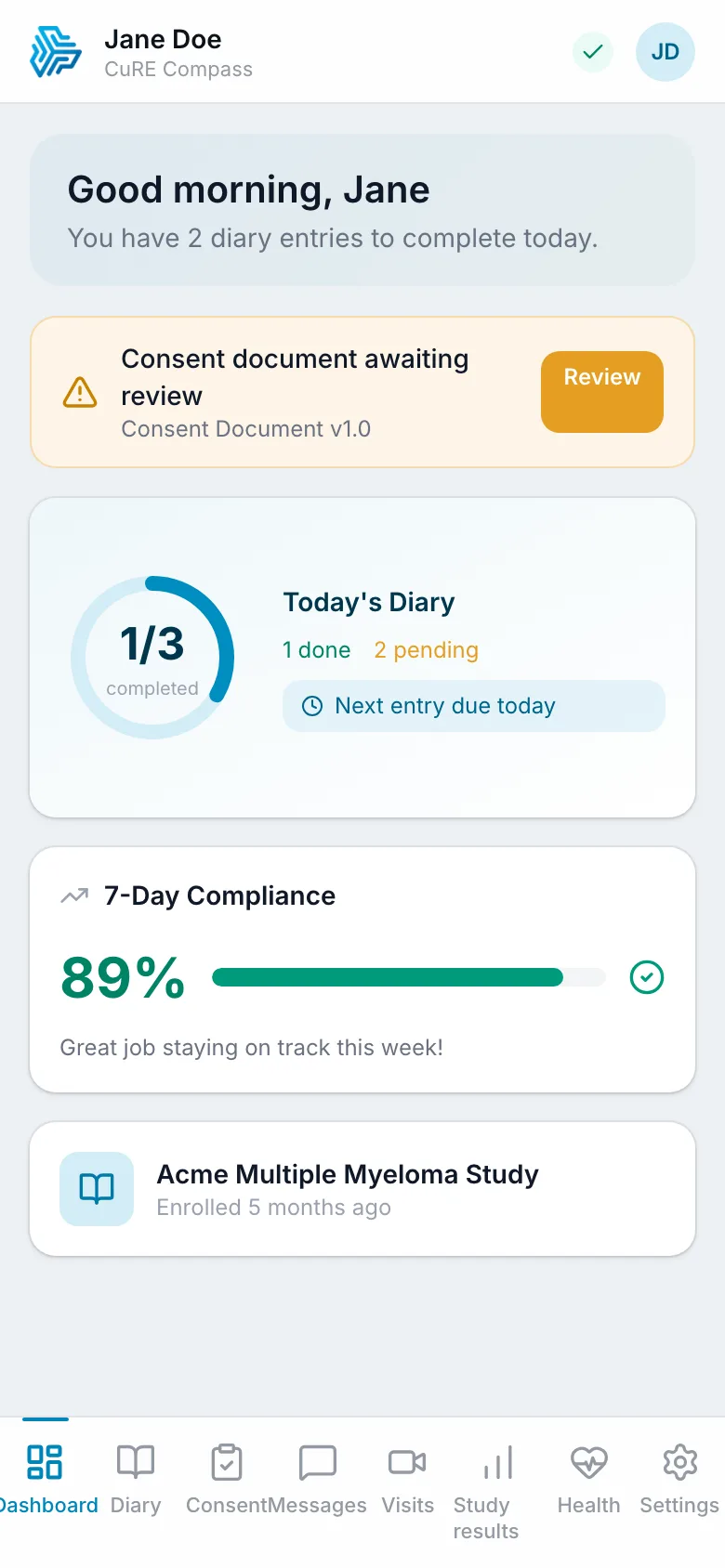
Patient portal — ePRO, eConsent, dosing diaries, and the patient's longitudinal health timeline.
What it does
Multilingual patient engagement: visit-anchored ePRO/eConsent, televisits, diaries, sensor ingestion, EHR timeline, and safety intake. The patient's own EHR record (via SMART on FHIR) sits alongside study-collected data — most ePRO tools only see what the study asks.
Key capabilities
- ePRO surveys + dosing diaries
- Visit-anchored ePRO scheduling (windows driven by the study visit schedule)
- Native mobile push reminders + adherence nudges (dose-due, ePRO-window, visit) with tap-to-open deep linking
- eConsent (mobile + web)
- In-portal televisits with the study team (patient and coordinator rooms, session notes on the study record)
- Consent-gated televisit recording (per-study opt-in plus the patient's own affirmative, withdrawable consent)
- Multilingual patient UI + per-patient ePRO instrument localization (RTL-ready, incl. Arabic)
- SMART-on-FHIR personal health record
- Longitudinal patient timeline
- Safety triage across patient-reported sources
- DHT / wearable / sensor ingestion into OMOP
- AI eConsent with comprehension assessment
- Retention & adherence-risk prediction
- Native iOS/Android app alongside the web portal
- Plain-language trial-results return to participants (staff-authored, patient-facing)
What sets it apart
- The patient's own EHR record (via SMART on FHIR) sits alongside study-collected data — most ePRO tools only see what the study asks.
- ePRO windows open automatically off the study's visit schedule — Control authors the schedule once and Compass opens the right survey in the right window, no manual per-patient setup.
- Patient payments, validated instruments, provisioned devices, wearable/sensor streams, safety intake, and gene-therapy long-term follow-up (up to 15 years) round out the eCOA surface.
- Each patient sees the app and their ePRO instruments in their own language, right-to-left scripts included — the UI localizes and validated instrument translations render per patient, not a US-English-only build.
- ePRO + eConsent + diaries in one app, not three vendors stitched together.
- Televisits run inside the patient portal, not behind a separate video link — the visit, its session notes, and the recording permission land on the same study record and audit trail. Recording starts only when the study has opted in and the patient has given their own affirmative consent, which they can withdraw at any time without touching their study consent.
- Patient-reported signals feed safety triage automatically — a concerning report surfaces to the care team instead of waiting in an inbox.
Score a patient-reported health state, live
Complete the EQ-5D-5L instrument the way a patient would — one statement per dimension, plus the 0–100 VAS self-rating — and watch the single health-utility index recompute in your browser from a published country value set, with the per-dimension decrement breakdown, the interpretation band (including the worse-than-dead region below zero), and a value-set switcher that re-weights the same health state by country.
Pick the one statement that best describes you in each group, then rate your overall health on the scale.
I have slight problems walking
I have no problems washing or dressing myself
I have slight problems doing my usual activities
I have slight pain or discomfort
I am slightly anxious or depressed
0 = the worst health you can imagine · 100 = the best. Reported alongside the index, not folded into it.
Devlin et al. 2018 (Health Econ 27:7–22)
How the index is built · 1 − Σ decrements
Each level above 1 subtracts its published dimension decrement from full health. Level-1 dimensions contribute nothing. This is the exact additive value-set model — the number is a preference-weighted utility, not a symptom count.
Same health state, every value set
| Country | Index | Band | Citation |
|---|---|---|---|
| England | 0.751 | Mild impairment | Devlin et al. 2018 (Health Econ 27:7–22) |
| Netherlands | 0.743 | Moderate impairment | Versteegh et al. 2016 (Value Health 19:343–52) |
The same 5-digit profile scores differently by country — value sets encode a population's preferences, so a health state Dutch respondents weight more heavily lands lower there than in England. Every index above is computed in your browser from the published coefficient tables — no backend.
Why this is more than a toy
The index here is the exact published EQ-5D-5L additive value-set model — England (Devlin et al. 2018, the NICE reference set) and the Netherlands (Versteegh et al. 2016), with the coefficient tables transcribed verbatim from the NICE value-set reference. A 5-digit profile becomes a single preference-weighted utility anchored at 1 = full health and 0 = dead, validated so 11111 scores exactly 1.000 and 55555 reproduces each set's published worst-state anchor. In the product, CuRE Compass administers validated ePRO instruments to patients and scores them in its ePRO scoring service (apps/compass/…/epro/scoring-service.ts) — this is the EQ-5D-5L utility index on that service's roadmap, running here entirely client-side on synthetic responses. No backend, no patient data.
See CuRE Compass in action
Every research ecosystem is unique. Let's discuss how CuRE can be configured for your needs.