RWD-native EDC · CRCs / Site coordinators
CuRE Capture
AI-driven validation EDC — clinical research data entry that catches errors at the keystroke.
What it does
AI-driven validation EDC — clinical research data entry that catches errors at the keystroke. Prevents work before it becomes work: AI checks reduce queries, SDTM mapping starts at capture, and validation evidence is ready from day one.
Key capabilities
- CRF authoring + data capture
- AI-powered validation at the field level
- Query management workflow
- 21 CFR Part 11 audit trail
- Multilingual eCRF + UI localization (per-locale labels, language switcher)
- Mid-study amendment form-version data migration
- 21 CFR Part 11 electronic signatures with re-authentication (per-meaning signature policies + signature audit export)
- Study/site database lock with an e-signed hard-lock ceremony
- CDISC ODM 1.3.2 CRF export + governed download
- AI source-document extraction into human-attested CRF pre-fill
- Offline capture with per-device HMAC sequence-chain verification and conflict reconciliation
- MedDRA/WHODrug coding workbench with AI code auto-suggest
- Governed clinical-derivation rule authoring with immutable version receipts, exact-version editing and forking, and bounded synthetic-case simulation
- AI-targeted (risk-based) SDV selection
- Targeted-vs-actual SDV completion KPI (site + study roll-up, daily trend)
- Subject/form-level monitor sign-off (e-signed re-auth, audit-chain-bound, scope-versioned)
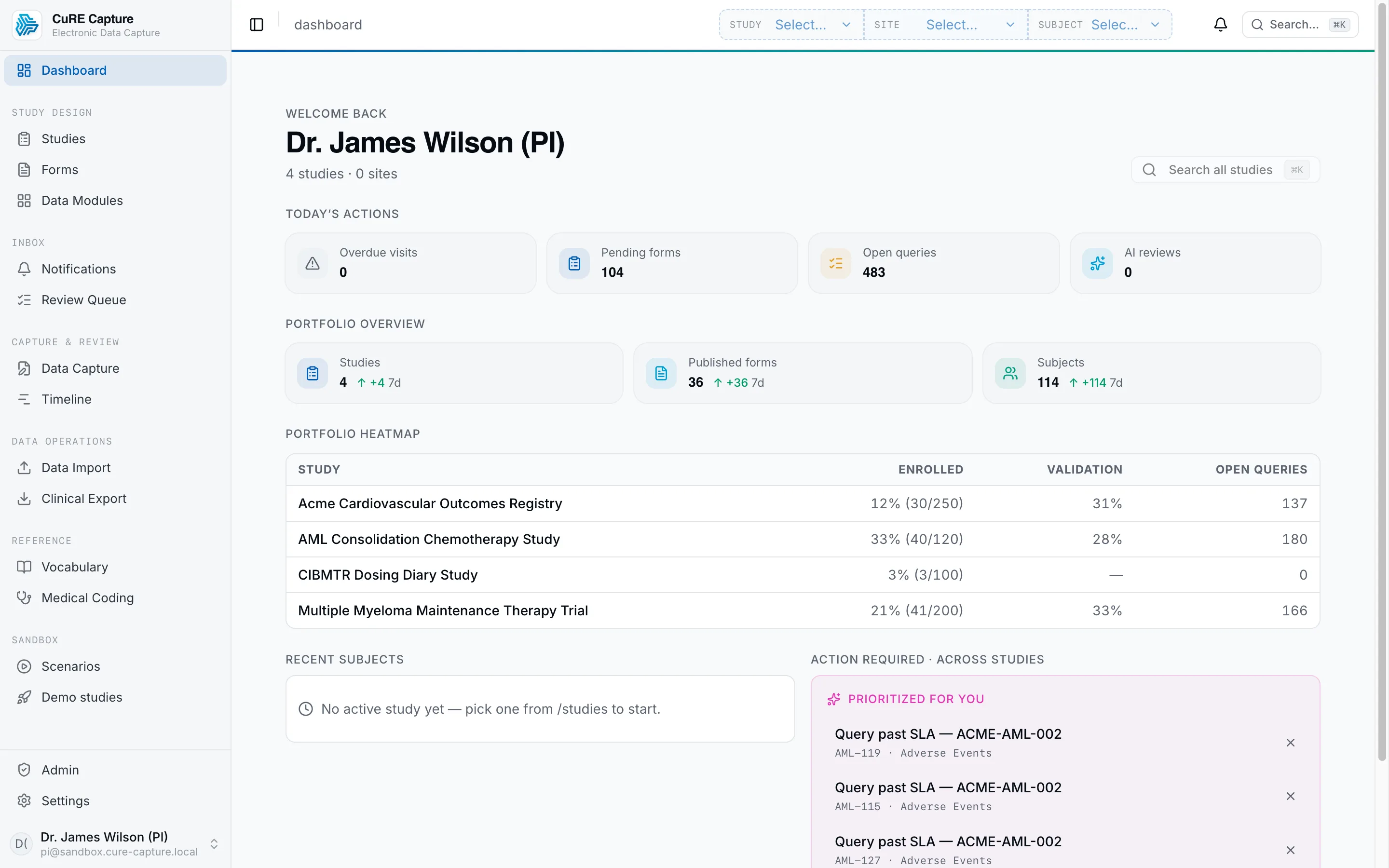
What sets it apart
- Prevents work before it becomes work: AI checks reduce queries, SDTM mapping starts at capture, and validation evidence is ready from day one.
- Handles the mid-study amendment: forms are versioned and in-flight subject data migrates across the amendment — the disqualifier most EDCs fail.
- Blinding firewalls, local-lab reference ranges, and offline capture round out the site-facing capture surface.
- AI validation is contextual, not just range checks — catches inconsistencies across forms and prior visits.
- Clinical derivation rules stay Capture-owned and immutable: authors load an exact saved version, validate, edit or fork, save with owner-and-scope checks, and test up to 100 synthetic cases without reading production patient data. Saving never approves, publishes, or activates a rule.
- Audit trail is cryptographic-hash-chained (Part 11 + Annex 11), not a soft log.
Catch a bad value as it's entered
Enter values into a sample case report form and watch Capture's edit checks fire — an out-of-range lab or a physiologically implausible vital auto-raises a data query on the spot, with a 21 CFR Part 11 audit attribution. Fix the value and the query clears; break a cross-field rule and a new one appears.
Subject 1042 · edit a value and validation re-runs on the spot.
Hemoglobin value 10.2 g/dL is outside the reference range (12–17.5). Please verify the source.
Systolic BP value 166 mmHg is outside the reference range (90–140). Please verify the source.
Each query is raised by the same field-save validation core CuRE Capture runs — the out-of-range comparator, cross-field consistency checks, template rendering, and the active-query de-duplication guard, all computed in your browser. In the product each auto-query is written with a 21 CFR Part 11 audit trail (source AUTO, opened by the system user, timestamped and hash-chained) and routed to a coordinator; here nothing calls a backend.
Why this is more than a toy
The validation running here is Capture's actual field-save auto-query core, ported dependency-free from the monorepo (apps/capture/…/data-capture/auto-query-service.ts): the out-of-range comparator, cross-field consistency checks, the query-template renderer, and the active-query de-duplication guard, producing the same QueryFlag shape (source AUTO, status OPEN, system-attributed). In the product each query carries a hash-chained 21 CFR Part 11 audit trail and routes to a coordinator; here it all runs client-side on synthetic data. No backend.
See CuRE Capture in action
Every research ecosystem is unique. Let's discuss how CuRE can be configured for your needs.